
Service
Asphalt Repair & Patching
Targeted asphalt repair across Calgary for potholes, failed patches, alligator cracking, and damaged parking lot surfaces. Hot mix asphalt for repair work. No cold patch.
Targeted asphalt repair across Calgary for potholes, failed patches, alligator cracking, and damaged parking lot surfaces. Commercial Paving uses hot mix asphalt for repair work. No cold patch.
Asphalt repair is about choosing the right fix for the condition of the pavement. Some areas only need a surface patch. Other areas, especially where the asphalt is cracking apart or moving under traffic, need to be cut out, removed, and rebuilt from the base up.
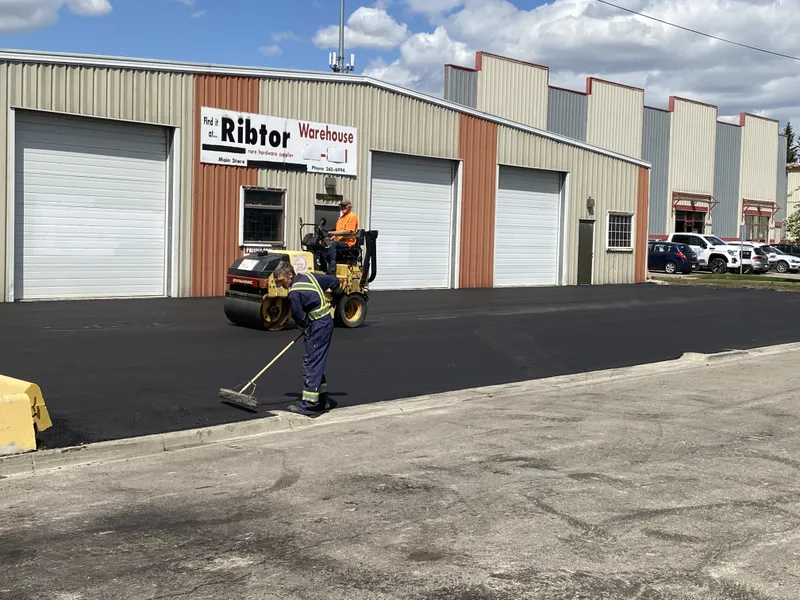
For most potholes and surface failures, a hot mix patch is the right repair. The area is cleaned, tacked, filled with hot mix, raked neatly into place, compacted with a roller, and finished so the edges tie cleanly into the existing asphalt.
For alligator cracking, soft spots, or sections where the asphalt has failed underneath the surface, patching over the top usually is not enough. Those areas are typically handled as a remove-and-repair: saw cut the perimeter, excavate the failed asphalt, correct the base, then place and compact new hot mix.
Crack filling is also available when specifically requested, but it is not the same as asphalt repair. It can help seal narrow cracks temporarily, but it does not hold up as well as a proper patch or remove-and-repair when the pavement is already failing.
Asphalt Repair
Parking Lot Repair & Patching
Parking lot patching is the most common asphalt repair service for commercial properties, condo lots, retail plazas, industrial yards, and private roads.
This is the right fit for potholes, small failed areas, edge breaks, and surface-level damage where the base is still in usable condition.
Project types
- Pothole repair
- Surface patching
- Edge repairs
- Small failed asphalt areas
- Trip hazard repairs
- Tie-ins around existing asphalt, concrete, or drains
How it’s done
- 01Clean the repair area with a blower or blowpack
- 02Apply tar and tack coat for proper bonding
- 03Shovel hot mix asphalt into the patch
- 04Rake and shape the patch for clean edges
- 05Compact with a roller
- 06Apply sand where needed to fill small cracks or imperfections
Asphalt Repair
Remove and Repair
Remove-and-repair is used when the asphalt damage is deeper than a surface pothole.
This is usually the better option for alligator cracking, soft areas, failed sections, or places where the asphalt is breaking apart because the base underneath is no longer supporting it properly.
Patching over alligator cracking may make the surface look better for a short time, but it does not solve the underlying problem. If the base has failed, the damaged asphalt needs to come out.
Project types
- Alligator cracking
- Failed asphalt sections
- Soft or moving asphalt
- Repeated potholes in the same area
- Large broken areas
- Areas with poor base or drainage issues
How it’s done
- 01Saw cut the perimeter for clean edges
- 02Excavate the broken asphalt with a Bobcat
- 03Haul away the removed asphalt
- 04Inspect and correct the base
- 05Add, remove, regrade, or compact gravel as needed
- 06Apply tar and tack coat once the base is solid
- 07Place fresh hot mix asphalt
- 08Rake, shape, and compact with a roller
- 09Finish edges cleanly to tie into surrounding pavement
Asphalt Repair
Crack Filling
Crack filling is available when requested, but it is not usually the first repair recommendation.
It can help seal certain cracks and slow water from getting into the pavement, but it does not rebuild failed asphalt and it generally does not hold up as well as a hot mix patch or remove-and-repair.
Crack filling may make sense for narrow cracks in otherwise stable asphalt. If the pavement is already broken, loose, alligator cracked, or moving, patching or remove-and-repair is usually the better option.
Project types
- Narrow surface cracks in otherwise stable asphalt
- Spot crack sealing on request
- Crack work alongside a broader patching scope
The process
The process, step by step.
- 01
Walk-through and assessment
The site is reviewed to separate surface-level potholes from deeper structural failures. Potholes, cracking, soft spots, drainage issues, and high-traffic areas are identified.
- 02
Written scope and quote
The recommended repair method is laid out clearly: patching, remove-and-repair, or crack filling if requested. The quote explains what is being repaired and how the work will be completed.
- 03
Site preparation
Loose debris, dust, broken asphalt, and soft material are removed from the repair area. For patching, the area is cleaned with a blower or blowpack. For remove-and-repair, the failed area is saw cut and excavated.
- 04
Base preparation where needed
If the repair is structural, the base is corrected before new asphalt is placed. Gravel may be added, removed, graded, and compacted so the new asphalt has a proper foundation.
- 05
Tack coat and hot mix
Tar and tack coat are applied to help the new asphalt bond to the existing surface. Hot mix asphalt is placed into the repair area.
- 06
Raking, shaping, and edge work
The hot mix is raked into place and shaped so the patch has clean edges and a proper tie-in to the surrounding asphalt.
- 07
Roller compaction and final finish
The repair is compacted with a roller. Where needed, sand may be added at the end to fill small cracks or imperfections around the patch.
Frequently asked
Common asphalt repair questions.
Do you use hot mix or cold patch?
Commercial Paving uses hot mix asphalt for repair work. Cold patch is not used for permanent repairs.
When is patching the right option?
Patching is usually the right option for normal potholes, small failed areas, edge breaks, and surface damage where the base is still in decent condition.
When does asphalt need to be removed and repaired?
Remove-and-repair is usually recommended for alligator cracking, soft spots, repeated failures, or areas where the asphalt is breaking apart because the base underneath has failed.
Why not just patch over alligator cracking?
Alligator cracking usually means the problem is below the surface. A surface patch may not hold because the asphalt underneath is already cracked, loose, or unsupported.
Do you offer crack filling?
Yes, crack filling is available when specifically requested. It can help with certain cracks, but it is not usually recommended as the main repair method because it does not hold up as well as proper patching or remove-and-repair.
Can the work be done without closing the whole lot?
In many cases, yes. Repairs can often be staged so parts of the parking lot remain usable while work is completed in sections.
Concrete and line painting are also coordinated on bundled jobs.
When curbs, sidewalks, line painting, or wheel stops are needed as part of a paving project, that work gets handled alongside the asphalt. One point of contact, one invoice, one schedule. Standalone concrete or line-painting work is not offered.
Other services
Safety
Commercial Paving is COR certified.
Our health and safety program holds a Certificate of Recognition (COR), issued with the Alberta Construction Safety Association and the Government of Alberta after an independent audit. On your site that means hazard assessments before work starts, trained operators, inspected equipment, and a crew that works safely around your tenants and traffic.
Ready for a quote?
Call, email, or send the project details through the form. A reply usually goes out the same business day with straight answers.
Or email directly at sales@commercialpaving.ca